
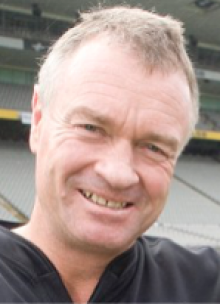
Grant Fox MBE is one of New Zealand rugby’s most influential and respected figures—renowned for his precision kicking, tactical intelligence, and steady leadership at fly-half during one of the most defining eras in All Blacks history. A key architect of New Zealand’s 1987 Rugby World Cup triumph and a consistent performer throughout the 1980s and early 1990s, Grant helped shape the modern role of the first five-eighth and laid the foundation for many who followed.
Born in New Plymouth, Grant grew up in Auckland, where he attended Auckland Grammar School and later the University of Auckland. A naturally talented sportsman, he initially excelled at cricket but gravitated toward rugby, where his calm temperament, strong kicking game, and ability to direct play quickly set him apart. Though not the most physically gifted player, Grant made up for it with incredible discipline, mental strength, and flawless technique.
He made his debut for Auckland in 1982 and quickly became a cornerstone of their provincial dynasty. Under the coaching of John Hart, Auckland dominated the New Zealand domestic scene, winning multiple National Provincial Championship (NPC) titles and defending the Ranfurly Shield for an unprecedented stretch. Grant’s role was pivotal—his metronomic goal-kicking and ability to control field position made Auckland nearly unbeatable during this period.
Grant debuted for the All Blacks in 1985 against Scotland and soon established himself as the team’s premier first five-eighth. At a time when rugby was shifting toward a more structured, tactical style, Grant thrived. He was a master tactician—comfortable playing for territory, setting up his forwards, and capitalising on opposition errors with clinical goal-kicking. His accuracy with the boot was legendary, and he ended his Test career with 645 points from 46 Tests—at the time, a New Zealand record.
The crowning achievement of Grant’s international career came in 1987 when he played a central role in New Zealand’s Rugby World Cup victory. The inaugural tournament, held in New Zealand and Australia, saw the All Blacks dominate the competition, with Grant guiding the backline superbly. He finished the tournament as the top points scorer, and his calm decision-making under pressure helped lead the All Blacks to a commanding 29–9 win over France in the final at Eden Park. That World Cup win was not just a milestone for the team—it helped define rugby’s global era, and Grant was at its heart.
He continued to represent New Zealand with distinction through to 1993, including tours to Europe and a fierce series of Bledisloe Cup battles against Australia. Though his style was sometimes viewed as conservative compared to more flamboyant players, his effectiveness was unquestioned. Grant was a player his teammates trusted and coaches depended on—a steady hand guiding the team through pressure and chaos alike.
After retiring from playing, Grant Fox speaker and great of the game remained heavily involved in rugby. He took up commentary roles with New Zealand television, where his insights, sharp analysis, and measured delivery made him a valued voice of the game. He also became involved in coaching and player development, most notably serving as a selector for the All Blacks from 2011 onward. In that role, he was part of the team’s golden era under Steve Hansen, contributing to the 2015 Rugby World Cup win and a long period of dominance at the top of world rugby.